
Clay Resident Lookup Records
One Clay name can appear in several systems, each answering a narrower question. The county property roll connects a person or entity to a parcel and tax-mailing address. The voter tool confirms election information for a registered voter. Court and probate indexes can show a party or estate role. Vital and library indexes supply event or historical leads. A result is strongest when its date, custodian, and match reason are written down rather than merged into a single unsupported profile.
| Record | What It Confirms | Where | Access |
|---|---|---|---|
| Assessment and tax roll | Parcel association and tax-mailing address | Town Assessor; RPTS Beacon and Image Mate | Public property data, with accuracy caveat |
| Deed and mortgage index | Parties, legal parcel, and recording event | Onondaga County Clerk and Cott eSearch | Guest index is free; images and printing have account terms |
| Voter registration lookup | Registration and poll information | New York State Board of Elections | Public under Election Law §3-220, with protected fields withheld |
| Court or probate index | Party, attorney, or estate connection | NYS eCourts and WebSurrogate | Public index subject to restricted-record rules |
| Vital and library index | Birth, death, marriage, obituary, or newspaper lead | County Vital Statistics, NY DOH, and OCPL | Indexes differ from restricted record copies |
Start with the source that matches what is known. An address can lead to the RPTS parcel record; county and date of birth can support the voter search; an estate question belongs with WebSurrogate; and a historical name often belongs at OCPL. The Town of Clay does not publish one general resident list.
Clay Resident Lookup Needs Two Matches
For a Clay resident lookup, normalize the name first. Keep middle initials, suffixes, former surnames, hyphens, and corporate-trustee wording in the search note. The county’s property gateway describes owner-name searching as the name “as it appears on property deed,” so a familiar spelling may not match the index. Older Cott records can also place a space or underscore after “MC”; search the second name part with Contains and inspect the variants.
Require two independent clues before treating a result as the same person. Useful pairs include the same street plus a published activity, the same parcel plus a spouse notation, or the same county plus a business filing. A current owner’s mailing address may help locate a contact route, but it is not proof that the owner lives at the parcel. Likewise, a directory, obituary, court appearance, or public filing has its own date and error risk.
Match rule. Keep the source name, coverage date, name variant, and reason for each Clay match so a later record can be tested rather than assumed.
Confirming Clay Registration Details
The New York State Voter Registration Look-up asks for county, last name, first name, and date of birth, with ZIP Code available for narrowing. A match returns registration, poll-site, and mail-ballot information for a registered voter. Select Onondaga County and retain the search date in the research note. The tool is designed for individual election access, not for a street-wide or ZIP-wide roster.
New York Election Law §3-220 makes registration records public under Board supervision, while driver-license numbers, non-driver ID numbers, Social Security numbers, and facsimile numbers are excluded. The state’s voter-file FOIL process requires an elections-purpose statement. A protected participant may have a substitute address or no ordinary address in a public-facing result. Do not use other sources to work around that protection.
For correction, active-status, or local procedure questions, contact the Onondaga County Board of Elections, not the County Clerk. Note: A voter result confirms election-system information at a point in time, not ownership or continuous residence.
Checking Clay Court and Probate Names
Clay Town Court has no identified public Clay-specific online docket index. For local calendars, copies, or older files, contact the court. The statewide NYS eCourts route separates systems by court type. WebCivil Local supports index, party, attorney or firm, judge, calendar, and eTrack views; its party screen can filter by party role, court, case type, filing year, status, future appearances, sort order, and HTML or PDF output.
Use WebCivil Supreme for Supreme Court party or index searches. For an estate, WebSurrogate supports party-name, death-date, file-number, and older index-book searches. It states that images are available for filings on or after February 19, 2014, while older unrestricted documents may be viewed at public-access computers. Safekeeping wills and restricted documents are not public. The Onondaga Surrogate’s Court is the custodian route for estate file questions.
Do not read a docket as a conclusion about a person. Sealed, expunged, juvenile, adoption, and protected Family Court material can be absent. A useful citation contains the court, index or docket number, party role, filing year, source date, and any displayed status.
Verifying a Clay Resident Across Records
Anchor a Clay name to one precise record before adding a second. If the address is known, begin with the RPTS property record or the county GIS viewer, save the tax-map number, and distinguish the situs from the mailing address. Then use the person’s spelling in a public index that has a different purpose. Onondaga County Real Property Tax Services links the official Beacon, GIS, tax-map, and tax-information routes.
- Write the full name, all observed variants, known Clay or postal-city address, approximate year, and source that supplied the lead.
- Use the relevant county parcel source to record the tax-map number, situs address, owner name, mailing address, and assessment year without treating those fields as the same fact.
- Search the voter lookup when the required county and date-of-birth information is lawfully available, or choose the court or probate index when the lead is a case or estate.
- Check the County Clerk’s recorded-document index for grantor or grantee names and compare the legal description to the parcel.
- For a historical question, ask OCPL for a directory, obituary, census, or newspaper lead, then record why the second source fits.
- Docket
- A court’s case record identifier and event trail, not a finding that every listed allegation or fact is proven.
- Index versus image
- An index lists searchable record facts; an image is the document page itself and may be restricted, unavailable, or subject to a fee.
- Certified copy
- A copy authenticated by its custodian for an authorized purpose; it is different from a public index entry or research lead.
When a search moves from one address to other people on that street, use the address-focused process on the Clay street directory page instead of treating a one-person match as a block result.
Clay Resident Lookup Result Fields
Copy the fields that the official result actually displays. A live Beacon parcel result and a live Cott row were not captured in the research, so exact labels and values should not be invented. The county’s official descriptions support a practical transcription checklist. It keeps an address match, a land record, and a court result distinct even when the same name appears in each place.
| Parcel record | Tax-map number, situs address, owner, mailing address, assessment details, districts, prior-sale fields if shown, and update date. |
|---|---|
| Recorded document | Instrument or book/page, recording date, document type, grantor, grantee, legal description, municipality, and image or print status. |
| Court result | Court, index or docket number, case type, filing date, party role, status if shown, calendar details, and document availability. |
| Voter result | Only the registration and poll information displayed by the official lookup, with its search date. |
County land records begin in 1794, but the official sources do not identify one online image cutoff. Cott guest mode allows free index viewing; image viewing or printing requires an account, and not every index has an image. When the web record stops, ask the Clerk about deed books, microfilm, office terminals, and archival retrieval.
Clay Resident Lookup Vital Routes
Vital material can confirm that an event occurred, but it does not make every certificate public. The Onondaga County Office of Vital Statistics keeps county birth and death records and accepts eligible requests by mail, fax, online, and in person. It is at the Civic Center, 421 Montgomery Street, Suite 20 in Syracuse. County genealogy instructions say deaths older than 50 years may be requested by anyone for an uncertified genealogy copy, while births older than 75 years require the person to be known deceased. Younger records need direct-descent proof or another authorized basis.
For a birth parent, use the official New York Adoption Registry and an authorized confidential intermediary route, not a public-name search. The New York Department of Health holds statewide records, and vital records are not available through FOIL. A directory, obituary, or library index can supply a name, date, and place lead, but it does not authorize a restricted copy.
Open the Onondaga County birth-record request instructions for the source of this Clay resident lookup image.
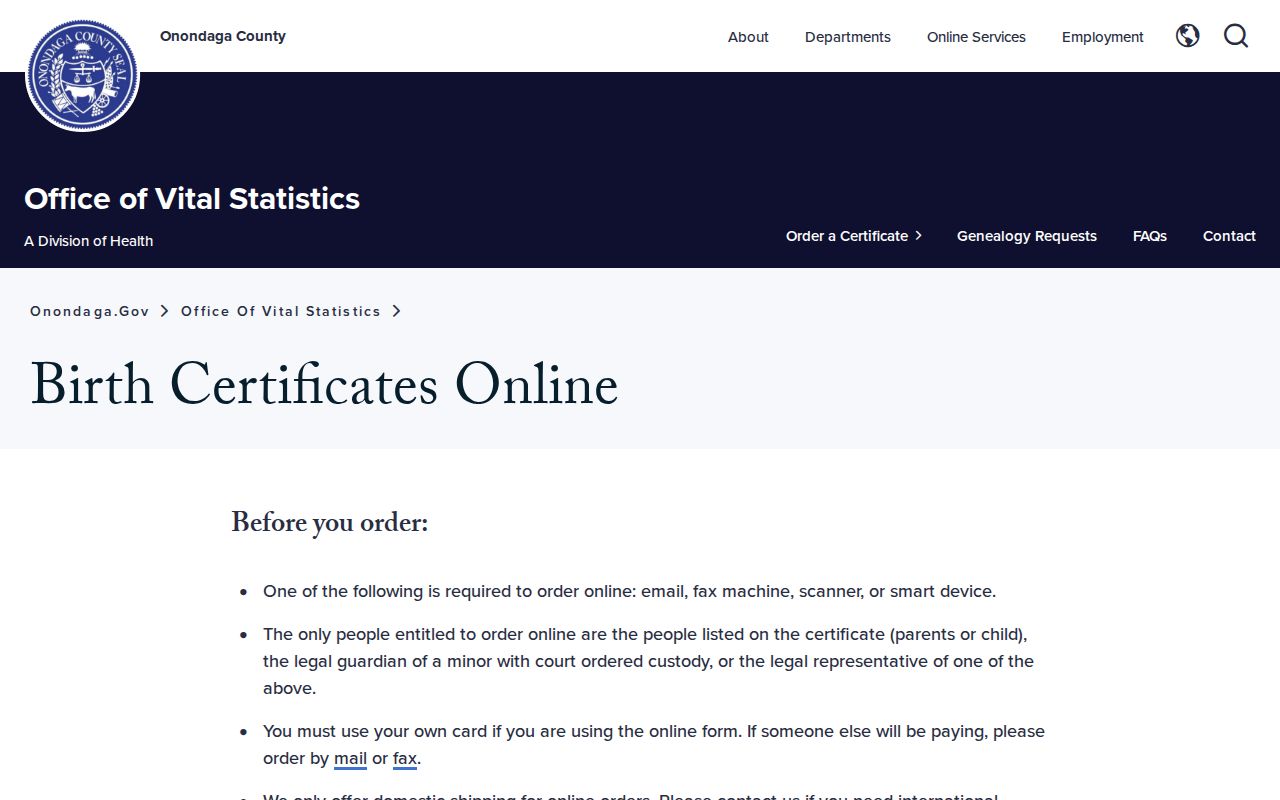
The request route asks for applicant, subject, parent, event, eligibility, identification, payment, and verification details, which is why a name-only search is not enough for a restricted copy.
Clay Resident Lookup Privacy Limits
New York’s Address Confidentiality Program under Executive Law §108 provides a free substitute mailing address and mail forwarding for qualifying participants. State and local agencies must accept that substitute address and should not retain the actual address except in justified law-enforcement or court-order situations. Protected-voter designation is a separate safeguard. A substitute or missing ordinary address is a stop signal, not a puzzle to solve with property, court, or business clues.
Property errors go to the Town Assessor or RPTS. A recorded-document issue goes to County Clerk recording staff, a voter issue to the Board of Elections, a vital correction to the issuing registrar, and a court-index issue to the particular court. Preserve the instrument, case, or index number and ask the custodian for its correction process. New York’s ACP information explains the state program.
Lawful use. Use Clay records for personal, lawful research. New York law does not permit records to be used to stalk, harass, intimidate, or harm another person.
Clay FOIL Requests for Missing Records
When a targeted Clay record is not online, identify the custodian, record type, name or parcel, date range, and preferred format. The Town Clerk, County Clerk, Sheriff, court, and county vital office keep different record families. New York Freedom of Information Law, Public Officers Law Article 6 §§84–90, gives the route for records that are public and held by the agency. It does not require an agency to create a new research product or release an exempt record.
Under §89(3)(a), an agency must grant, deny, or acknowledge a written request within five business days and provide an approximate date when more time is needed. A denial may be appealed within 30 days. The usual copy baseline is $0.25 per page up to 9 by 14 inches, while larger or electronic production can have actual-cost or statutory rules. Use the New York FOIL guidance and ask the correct custodian before sending payment.
Note: A precise request has a record type and time range, while an agency need not answer a broad question about a person.