
Finding Clay Residents Through Records
Clay has no single public roll of every resident. A Clay property search is best when an address is known, while the Clay voter service is a current, person-by-person election check. The Clay County Clerk’s land index connects named parties to recorded parcels, and Clay library directories and newspapers are stronger for an earlier address. Each Clay source answers a narrower question. A Clay deed can establish a transfer, for example, while a directory may place an occupant at an address during the year it was printed.
Begin with the date as well as the name. A Clay parcel owner can use a different mailing address, a Clay voter record is limited to election information, and a Clay library entry is a snapshot rather than a live household count. Keep the Clay spelling, Clay source, and Clay search date with every result. That makes a Clay residents directory search easier to check when a common name, a trust, or a change in postal city produces a near match.
- Search the county property roll by address or owner name and save the tax-map number, situs address, owner spelling, and assessment year.
- Open the state voter lookup only for a known person, using the required name, county, and date-of-birth information.
- Use the parcel’s legal description and owner spelling in the County Clerk deed index to identify recorded transfers.
- For a past household, compare annual directories, telephone books, newspapers, and released census material at the library.
- When a needed town record is not online, ask its custodian for a narrow record, date range, and format under FOIL.
Note: A match is more dependable when two independent records agree on the person, location, and relevant date.
Clay Resident Records Offices
Clay residents turn up in records held by different custodians. The Clay County Clerk maintains Clay deeds, mortgages, and selected court custody, while Clay real-property systems maintain the tax-map and assessment infrastructure. The Clay elections route handles voter-registration questions. The Clay Town Clerk keeps town minutes, local licenses, forms, and the Town’s FOIL route. Asking the right Clay office first avoids treating one narrow index as a complete resident directory.
Onondaga County Clerk
401 Montgomery Street, Room 200
Syracuse, NY 13202
315-435-2227
Onondaga Board of Elections
1000 Erie Boulevard West
Syracuse, NY 13204
315-435-3312
The County Clerk public counter is open weekdays from 8:30 to 4:00. RPTS is at 421 Montgomery Street in Syracuse and answers county tax-map and bill questions, while the Clay assessor handles local roll and grievance questions. Town Clerk requests, county requests, and Sheriff requests are separate targets under New York Freedom of Information Law, so name the particular agency and record rather than sending a broad people search request.
Clay Parcel Searches by Address
Address work in Clay starts with the distinction between a situs and a mailing address. The situs is the physical parcel location. A mailing address receives tax correspondence and can be outside the Town. The official county systems are useful because they preserve both fields when they are available. They also provide a tax-map number, which is the bridge from a street address to the map and the land-record chain.
| Clay county search mode | Input | What it identifies | Important limit |
|---|---|---|---|
| Clay Tax Map Number | Clay parcel identifier | Clay mapped parcel and legal-record bridge | Not a Clay household identifier |
| Clay Owner Name | Name as shown on Clay deed | Clay property association | Clay owner may not occupy the parcel |
| Clay Property Address | Clay street number and name | Clay physical situs location | Clay postal-city variants can affect a search |
| Clay Mailing Address | Clay tax-notice address | Clay correspondence destination | Does not prove Clay residence |
The older official Image Mate gateway documents these four modes, and Beacon adds property information, prior sales, dimensions, and assessment values. The county GIS viewer can then locate the parcel, display visible layers at the needed zoom, measure, and export a dated PDF. Use the property class, roll year, and legal description as checks before connecting a name to a Clay residents directory result.
- Parcel
- A defined piece of land represented by a tax-map number.
- Situs address
- The physical address of a parcel, not necessarily the address for tax mail.
- Index
- A finding tool that points to a record; it is not always the record image itself.
- Criss-cross directory
- An address-oriented directory arrangement, when a volume includes one.
Clay Voter Lookup Fields and Limits
New York’s voter registration look-up is an election service, not a general Clay residents directory. Its visible form calls for County, Last Name, First Name, and Date of Birth. ZIP Code is shown as a narrowing field. A valid result can provide registration, poll-site, and mail-ballot information for the voter who is being checked. It cannot be used to browse an entire Clay street or ZIP for names.
The official New York voter lookup displays the required person-search fields shown below.
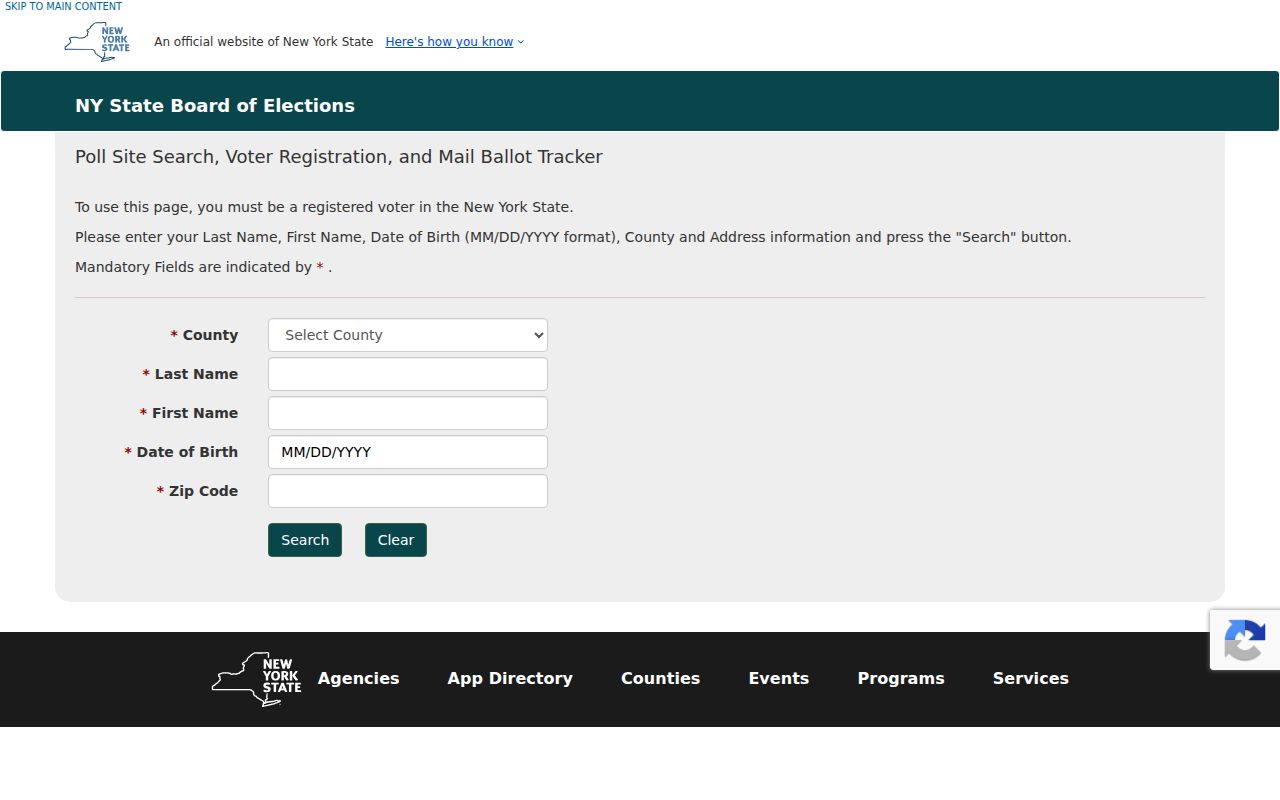
Retain the search date and confirm any name with a second, independent source. Election Law §3-220 makes registration records public under Board supervision, but SSN, driver-license and non-driver-ID data are withheld. Protected voters and Address Confidentiality Program participants may not show an ordinary residence address. A state voter-file request has an elections-purpose restriction, so it is not a substitute for a public street list.
Note: A voter result confirms election-system information at a point in time, not ownership or uninterrupted occupancy.
Clay Current Resident Directory Sources
Current Clay resident searches work best when the source is chosen for its role. The assessment roll identifies a parcel and an owner association. The voter service answers a registration question for one known person. The recorded-document index names parties to a legal transaction. Town staff listings identify public officials, not townwide residents. The table keeps those records distinct instead of making one source carry more weight than it has.
| Clay source | Best use | Custodian | Access channel |
|---|---|---|---|
| Clay assessment and tax roll | Clay parcel, owner, situs, and tax-mailing details | Clay assessor / county RPTS | Clay Beacon, Image Mate, counter, or phone |
| Clay GIS parcel viewer | Clay parcel position, nearby lots, and map context | Onondaga County GIS | Clay online viewer and PDF export |
| Clay recorded land index | Clay grantors, grantees, and document dates | Onondaga County Clerk | Clay Cott guest index, account images, counter |
| Clay voter registration lookup | One person’s Clay registration and poll information | NY State Board of Elections | Clay online form or elections office |
| Clay Town forms and minutes | Clay local action, permit, or meeting context | Clay Town Clerk | Clay Town pages, clerk contact, or FOIL |
Official Clay records identify their custodian, coverage, and access rules. A paid compiled people-data service may combine stale or mismatched sources and leave the reader unable to check a result. The difference matters when a name is common or a Clay postal label changes.
| Clay research source | What supports a match | How to correct an error |
|---|---|---|
| Official parcel, deed, court, voter, or library record | Named custodian, record date, and defined field set | Ask the original Clay or state custodian |
| Paid compiled people data | Unspecified mix of source data and update dates | Check the original Clay record before relying on it |
A current owner may be a trust, estate, business, or person with a different mailing address. For a single-person question, compare that result with a dated voter, court, business, or library lead rather than inferring a household. For a named road and its parcels, the address workflow belongs on the Clay street directory page.
Clay Deed Indexes and Owner Trails
Onondaga County land records begin in 1794. In Cott eSearch, guest access permits free index viewing; image viewing or printing requires an account or subscription. The Clerk lists $5 for 24 hours, $100 for 30 days, and $500 for 180 days, with printing at $0.65 per page. Not every indexed item has an image, and confidential divorce images are not public. Save the instrument or book-and-page reference as well as the party name.
A deed identifies grantor and grantee, legal description, recording information, and sometimes transfer-tax evidence. Start with the current owner’s acquisition, then search the seller as a prior grantee to move backward. A mortgage or satisfaction can place a financing event in time but does not itself prove a sale. For older names before August 21, 2017, try the part after “MC” with a Contains search because an index may use a space or underscore.
The Clerk’s free PropertyCheck service can send a name-based alert when a document is recorded. Its purpose is deed-fraud awareness, not resident matching. If a portal stops at an older item, ask the Clerk about deed books, microfilm, office terminals, or archival retrieval rather than assuming the absence of an image means the record never existed.
Note: Preserve the Clay parcel description with every deed result, especially when the same surname appears in several county transactions.
Clay FOIL Requests When Online Ends
Some Clay records have no public search screen. The Town’s permit, inspection, and zoning materials describe forms and procedures, but no official online address-result index was located. A focused request can name the address, tax-map number, date range, record type, and preferred electronic or paper format. The Town Clerk is the town route; Code Enforcement may hold the underlying permit or inspection material. Avoid asking an agency to create a new research product.
Town Clerk forms and permits information includes the FOIL request route used for these focused requests.
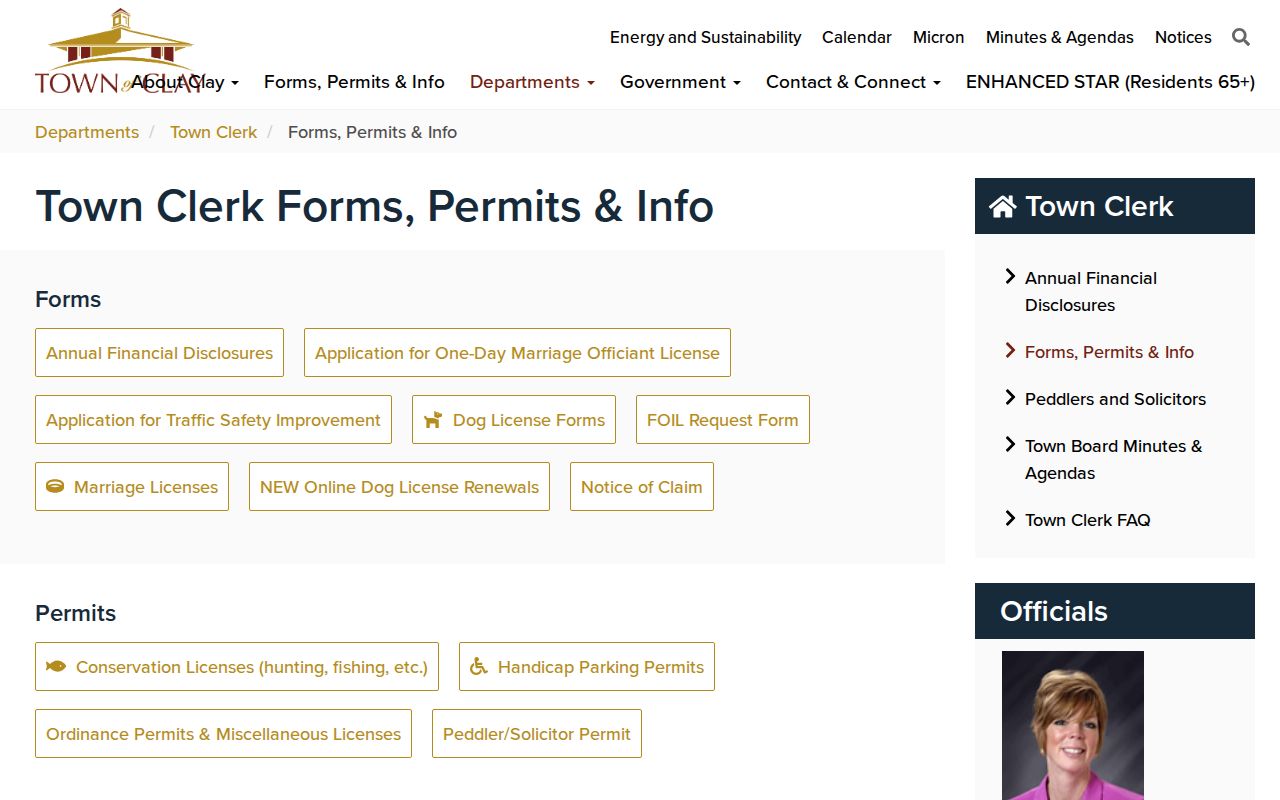
New York FOIL is Public Officers Law Article 6 §§84-90. An agency must grant, deny, or acknowledge a written request within five business days and give an approximate date when more time is required. The baseline copy fee is $0.25 per page up to 9 by 14 inches, with different rules for larger or electronic production. Keep each agency’s response with the record request.
Clay Custody and Registry Searches
Custody and registry tools are narrow public-record sources. The Onondaga Justice Center roster identifies people currently held at the facility; it is not a verdict and can change quickly. The state sex-offender registry has its own legal notice and is limited online to Level 2 and Level 3 records. Use either tool only for a lawful safety or records purpose, and never treat an entry as a complete history or current address confirmation.
The Onondaga County Sheriff lookup provides the official route to the Justice Center roster.
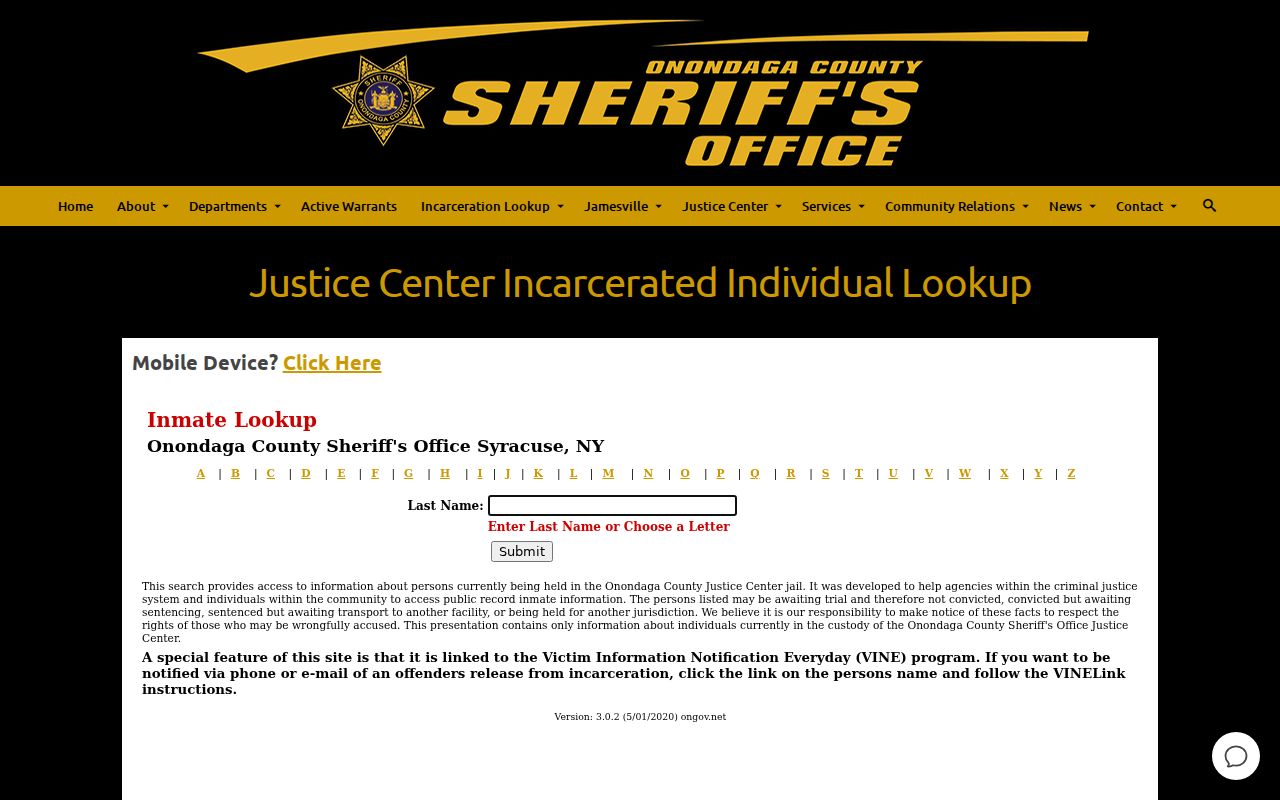
The roster’s published fields can include a name, age, court, next court date, charge sequence, bond information, and facility placement. Those fields describe custody status, not guilt. For a past court matter, use the particular court or NYS eCourts system and retain the docket number and date rather than relying on a roster screen.
The New York sex-offender registry search shows its permitted search modes and cautionary notice.
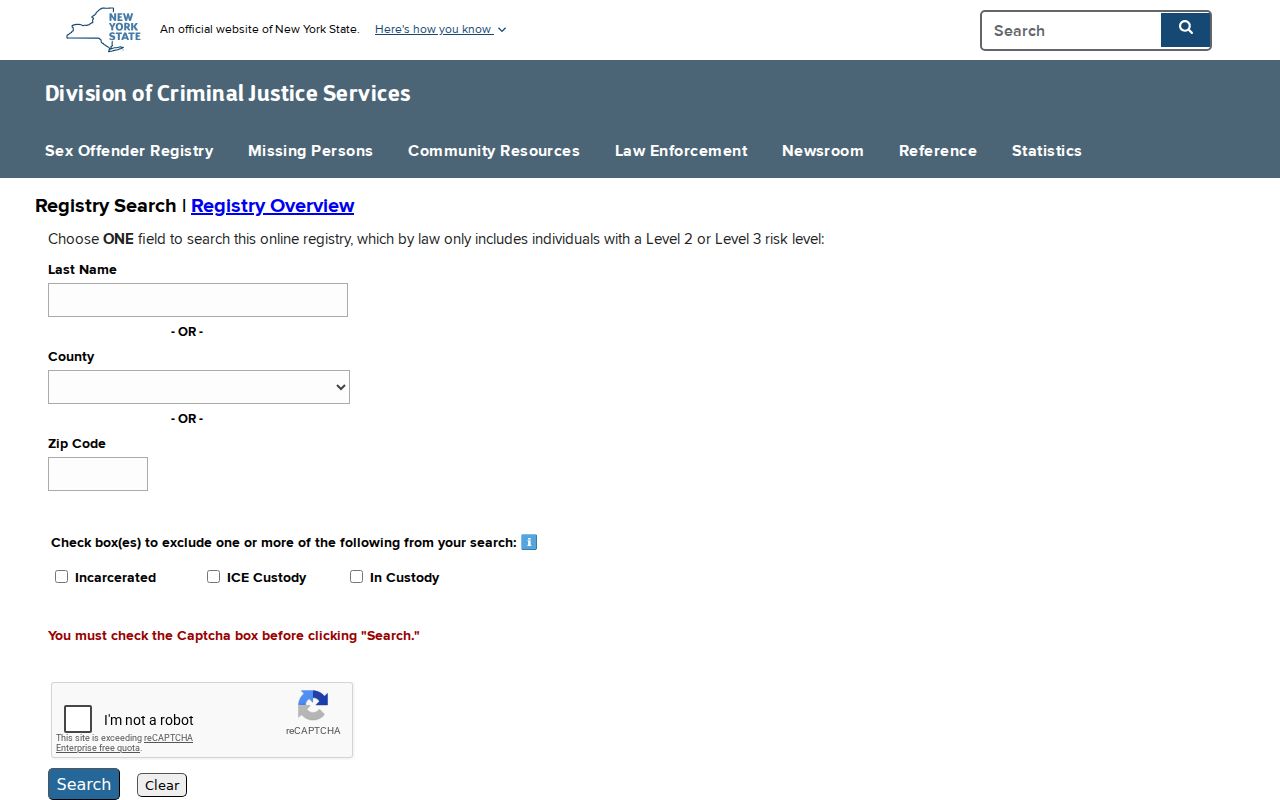
Level 1 information is available by telephone under the registry’s stated procedure, while the public web search applies to Level 2 and Level 3 records. A registry result does not authorize harassment, contact, or publication of sensitive information.
Clay Historical Resident Directories
For a historic Clay household, the strongest shelf is the Onondaga County Public Libraries Local History & Genealogy room on the Central Library’s third floor. Its Syracuse and suburban directories run in print from 1936 to the present, with earlier city directories on microfilm from 1862 to 1935 and some 1844-1862 microfiche. The library also holds telephone directories from 1894 onward, newspapers from 1850 to near the present, county census materials, cemetery cards, and an obituary index covering about 1860-1996.
The library reports that city directories through 1923 have digitized FamilySearch access, though accounts may be required. Read a directory entry with its year and street page: it can include an address, occupation, employer, spouse notation, or owner/renter mark, but it does not automatically prove ownership. The full holdings and household-tracing method are retained on the Clay city directory page.
When a name is absent, try the postal city, street name, Euclid, Gifford, Morgan Road, Pine Plains, or Hamlin Marsh. Clay records may be filed in Syracuse, refer to the Town, and use Liverpool, Brewerton, or North Syracuse as a delivery city. That three-part geography explains many missing keyword searches.
Note: Historical directory and newspaper leads should be paired with the record date, volume, page, and an independent source.
Clay Pine Plains Resident Trail
Pine Plains Cemetery is a useful endpoint for Clay family research because its history preserves several search terms. The Town historian records Peter Young’s burial on April 9, 1812, the cemetery’s incorporation in 1886, and town title in 1887. The site grew to about 70 acres, and the historian’s 2012 account counted 787 veterans. Those facts are historical context, not a current interment count or an online resident register.
No official online interment lookup was found. Start with the library’s county, town, and name cemetery-card resources, then contact the cemetery office through the Town when a particular burial needs confirmation. Search both Pine Plains and Old Town Cemetery in newspapers and family files. An obituary citation, grave record, probate file, and directory address can then form a dated chain without assuming that a surviving relative remains at the same location.
Note: Clay cemetery history provides place and date clues, while an office or archive must confirm a particular burial record.
Clay Land Records Go Digital
The County Clerk’s 2024 annual report gives a useful measure of the record stream behind a Clay parcel search. In 2024, the office reported 11,241 deeds, 10,791 mortgages, more than 11,000 satisfactions, 10,284 index numbers, and 7,254 judgments processed. It also reported 275,003 land-record pages entered into a digital database. That work improves finding access, but it does not establish that every older image or handwritten book is online.
The County Clerk’s 2024 annual report provides the underlying digitization figures.
Use the online index as the first stop, then preserve the instrument number, legal description, and date for a counter or terminal follow-up. County land records can reach back to 1794, while the precise online image cutoff was not located in official sources. This is why a Clay residents directory search should label a result as “not found online,” rather than “no record,” until the custodian confirms the series searched.
Clay Resident Privacy Boundaries
Public access has hard limits. New York’s Address Confidentiality Program, authorized by Executive Law §108, gives qualifying participants a substitute mailing address and forwarding service. A protected voter designation separately limits ordinary display of a voter’s actual residence. DMV personal information is controlled by the federal Driver’s Privacy Protection Act and New York procedures. Do not attempt to reverse a protected address with parcel, court, or business clues.
Use a Clay source date and direct a correction to the original custodian: the Clay assessor or RPTS for property data, the Clay Clerk for a recorded instrument, the Clay elections office for voter records, and the Clay court for a court index. Omit full dates of birth, protected addresses, SSNs, telephone numbers, and household-member guesses from a research note. A public record is evidence with a defined purpose, not permission to publish an unverified profile.
New York’s Address Confidentiality Program route provides the official program contact and application information.